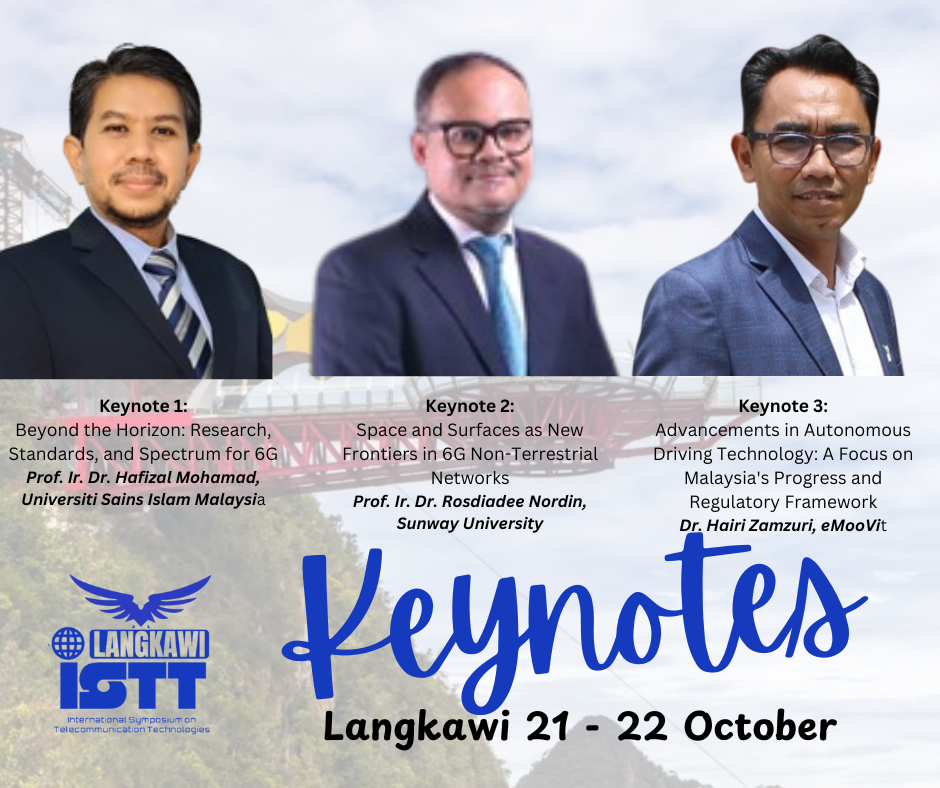
By Prof. Ir. Dr. Hafizal Mohamad, Universiti Sains Islam Malaysia
Abstract: As the evolution from 5G to 6G gains momentum, the upcoming generation of wireless technology promises a paradigm shift in global connectivity, with innovations that will redefine the limits of communication networks. This keynote will examine the foundational technology enablers for 6G to drive the future of wireless infrastructure and paving the way for transformative shifts in latency, bandwidth, and network scalability. Achieving the full potential of 6G, however, requires more than technical innovation; it calls for comprehensive international cooperation on spectrum allocation and rigorous standardization efforts. As 6G expands into new frequency bands, coordinated global policies and enhanced spectrum efficiency become essential to supporting ultra-reliable and ubiquitous connectivity. This talk will also highlight the roadmap for 6G standardization and setting the stage for a hyper-connected future where next-generation applications and services can thrive.
Biography:
 Hafizal Mohamad is the recipient of the ASEAN Outstanding Scientist and Technologist Award (AOSTA) 2017 and Top Research Scientist Malaysia (TRSM) by the Academy of Sciences Malaysia (ASM). Currently, he is a Professor at the Faculty of Engineering and Built Environment, Universiti Sains Islam Malaysia (USIM). He was a Senior Staff Researcher at the Corporate Technology Division, MIMOS Berhad. Hafizal has more than 20 years of working experience in the ICT industry and is passionate about creating a hyper-connected world. He is the co-inventor of 36 filed patents and 9 granted patents in the field of wireless communications. He served as a visiting fellow at NICT, Japan in 2005. He has published over 100 journal and conference papers. He has completed 19 R&D projects funded by both local and international agencies.
By Prof. Ir. Dr. Rosdiadee Nordin, Sunway University
Abstract: This talk introduces an innovative approach capitalizing on Reconfigurable Intelligent Surfaces (RIS) capabilities to significantly enhance 6G Non-Terrestrial Networks (NTN) performance. With its transformative ability to dynamically control electromagnetic wave propagation, RIS technology is poised to accelerate network optimization and signal enhancement, such as for hard-to-reach rural populations in Malaysia. The integration of RIS within NTN is expected to address some of the most critical challenges in wireless communications, including signal degradation due to distance, pervasive interference, and extreme atmospheric conditions, including the harsh tropical climate in Malaysia. This talk will share the current journey of a small wireless research group at Sunway University in NTN research to overcome the complexities of RIS-NTN integration and see how it fits Malaysia’s current and future socio-technological contexts.
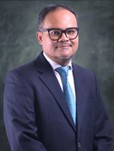 Biography: Rosdiadee Nordin received the B.Eng. degree from Universiti Kebangsaan Malaysia (UKM), in 2001, and the Ph.D. degree from the University of Bristol, U.K., in 2011. He is currently a Professor with the Department of Engineering, School of Engineering and Technology, Sunway University. His research interests include beyond 5G wireless communications, specifically focusing on advanced wireless transmission techniques and channel modeling, aerial wireless communications, and wireless communications for the Internet of Things applications. He was a recipient of the Leadership in Innovation Fellowship, the Technopreneur Program under the Royal Academy of Engineering, U.K., in 2021, and the Top Research Scientists Malaysia (TRSM), a Prestigious Award under the Academy of Science Malaysia, in 2020.
by Dr. Hairi Zamzuri, eMooVit
Abstract: As the global landscape rapidly evolves toward autonomous driving technology, Malaysia is making significant strides in integrating these advancements within its transportation ecosystem. This talk will explore the current state of autonomous driving in Malaysia, highlighting key developments and ongoing projects. Additionally, it will delve into the regulatory and legislative frameworks that are shaping the future of autonomous technology in the country. By addressing both the technological progress and the legal landscape, this presentation aims to provide a comprehensive overview of Malaysia’s journey toward a more autonomous and connected future.
 Biography: Dr Hairi Zamzuri has more than 20 years of experiences in developing, testing, and commercialization of autonomous intelligent vehicle systems. He received his B.Electrical Eng in control system from Universiti Teknologi Malaysia (UTM), Master of Electrical Engineering at the same university, and Ph.D. in the field of Artificial intelligence and control design from Loughborough University in 2008. Publish more than 100 papers with related to autonomous and active safety technology as researcher and academician before joining industries to further commercialise the technology. His have more than 8 years experiences in setting up technology compony compromise of business development, talent development, technology road map and product development life cycle especially in software and autonomous vehicle technology.
Dr Hairi Zamzuri currently a CEO of eMooVit Technology Sdn Bhd, focusing on design and development of autonomous driving software solutions for last mile autonomous bus for public transport.
Dr Hairi also actively as a speakers and consultations in autonomous driving in the area of technology, regulatory and policy for government agencies, universities, and private sectors.
Biography: Dr Hairi Zamzuri has more than 20 years of experiences in developing, testing, and commercialization of autonomous intelligent vehicle systems. He received his B.Electrical Eng in control system from Universiti Teknologi Malaysia (UTM), Master of Electrical Engineering at the same university, and Ph.D. in the field of Artificial intelligence and control design from Loughborough University in 2008. Publish more than 100 papers with related to autonomous and active safety technology as researcher and academician before joining industries to further commercialise the technology. His have more than 8 years experiences in setting up technology compony compromise of business development, talent development, technology road map and product development life cycle especially in software and autonomous vehicle technology.
Dr Hairi Zamzuri currently a CEO of eMooVit Technology Sdn Bhd, focusing on design and development of autonomous driving software solutions for last mile autonomous bus for public transport.
Dr Hairi also actively as a speakers and consultations in autonomous driving in the area of technology, regulatory and policy for government agencies, universities, and private sectors.